University of Washington

Men’s Coaches

James Knight

(1903-1906)

Originally hired by the UW as the head football and track coach, James Knight assumed the additional role of rowing coach in the spring of 1903. Recruiting came easy for his new team: he had access to the finest athletes on campus. He was himself an accomplished oarsman (first at Princeton, then the Detroit Rowing Club) and took to coaching the team naturally, the UW yearbook describing rowing as “the sport which he is preeminently able to coach, and the one which he loves.” Conditioning was the top priority for his team while teaching a more traditional rowing style.

It was Mr. Knight who presented to the University Club in Seattle the idea of helping to pay for California’s crew to come north and race in the spring of 1903. Through this presentation and others to local businessmen, the funds were raised to bring four athletes, a coach, and a manager to Seattle to race straight (no coxswain) fours on the 1.5-mile Leschi course. On June 3rd, 1903, Washington prevailed over California by three lengths, beginning The Dual tradition that lives on today.

Hiram Conibear

(1906-1917)

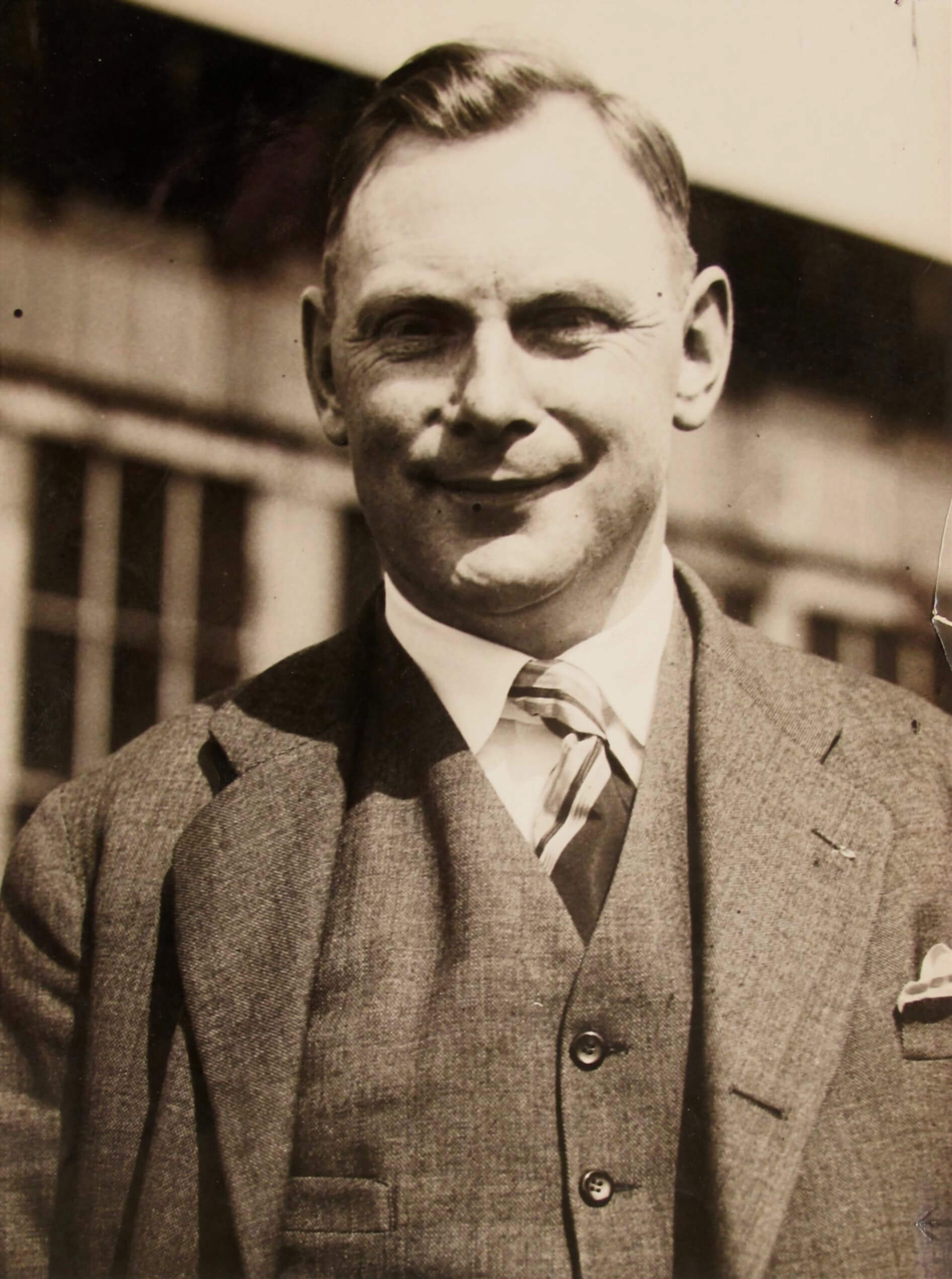
Considered the Father of Washington Rowing, Hiram Conibear arrived at Washington in the Fall of 1906 as a trainer (previously at the Chicago White Sox) for the Football and Track teams.  With James Knight heading back to the east coast and the rowing position vacant, the job was offered to Conibear – a former professional bicycle racer – as a last resort.  “I never did nothing but row a boat around a lagoon in Chicago” he said, “but if you want me, I’ll do what I can.”

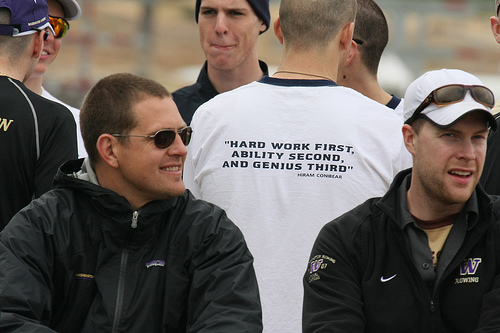
With limited knowledge and funds, and a makeshift boathouse floated with logs the team cut down themselves, Conibear immediately took to the sport. With all of the character and personality of a trailblazing entrepreneur, he set out to make Washington “the Cornell of the Pacific” (Cornell at the time being the dominant rowing team in the nation).  Through his contagious energy, it was Conibear that founded the Varsity Boat Club; successfully coached Women’s Rowing (very uncommon in the early 20th Century but highly popular at Washington); and created the Washington Rowing Stewards, all while establishing the values of hard work, team before self, and rowing to win that define Washington Rowing today.

Innovative and curious, and without institutional expectations of an already established rowing style, Conibear was free to adjust the mechanics and efficiency of the stroke he taught his oarsmen, ultimately developing a hybrid style of rowing that became known as the “Conibear Stroke”.  Through his own experimentation and understanding of physiology as a trainer, coupled with an open embrace of critique and input, he revolutionized the sport.  Recruiting the Pocock brothers from Vancouver B.C. to build shells for his burgeoning program in 1911, he welcomed their input as well, adjusting his theory and rowing mechanics to include multiple elements of their English style.

A consistent presence downtown soliciting funding from local businesses, coupled with a steadfast and unwavering vision of the future for Washington Rowing, Conibear convinced the IRA to offer an invitation to his team in 1913. Stunning the field with a close third place finish after a cross-country journey to Poughkeepsie, Conibear immediately used his newfound popularity back in Seattle to raise more funds for his growing team, while also applying the knowledge he gained from his east coast contemporaries to further adjust the ever-evolving Conibear Stroke.

By the time of his untimely death in 1917, the Conibear Stroke – now with a shortened layback and emphasis on leg drive – had changed the sport of rowing permanently, with key elements (both in posture and drive) remaining core principles today.  Remarkably, within just ten years of his death, the majority of top rowing coaches across the country were either former Conibear athletes, or had a direct connection to Washington – with all of them teaching the rowing style created by their mentor.  But even with all of that, it was ultimately Conibear’s dedication and appreciation for the Seattle community – and the structure and synergy he enacted and inspired – that would usher the program through a very difficult post-WWI athletics landscape, a period that threatened to extinguish west coast collegiate rowing altogether.

Hiram Conibear

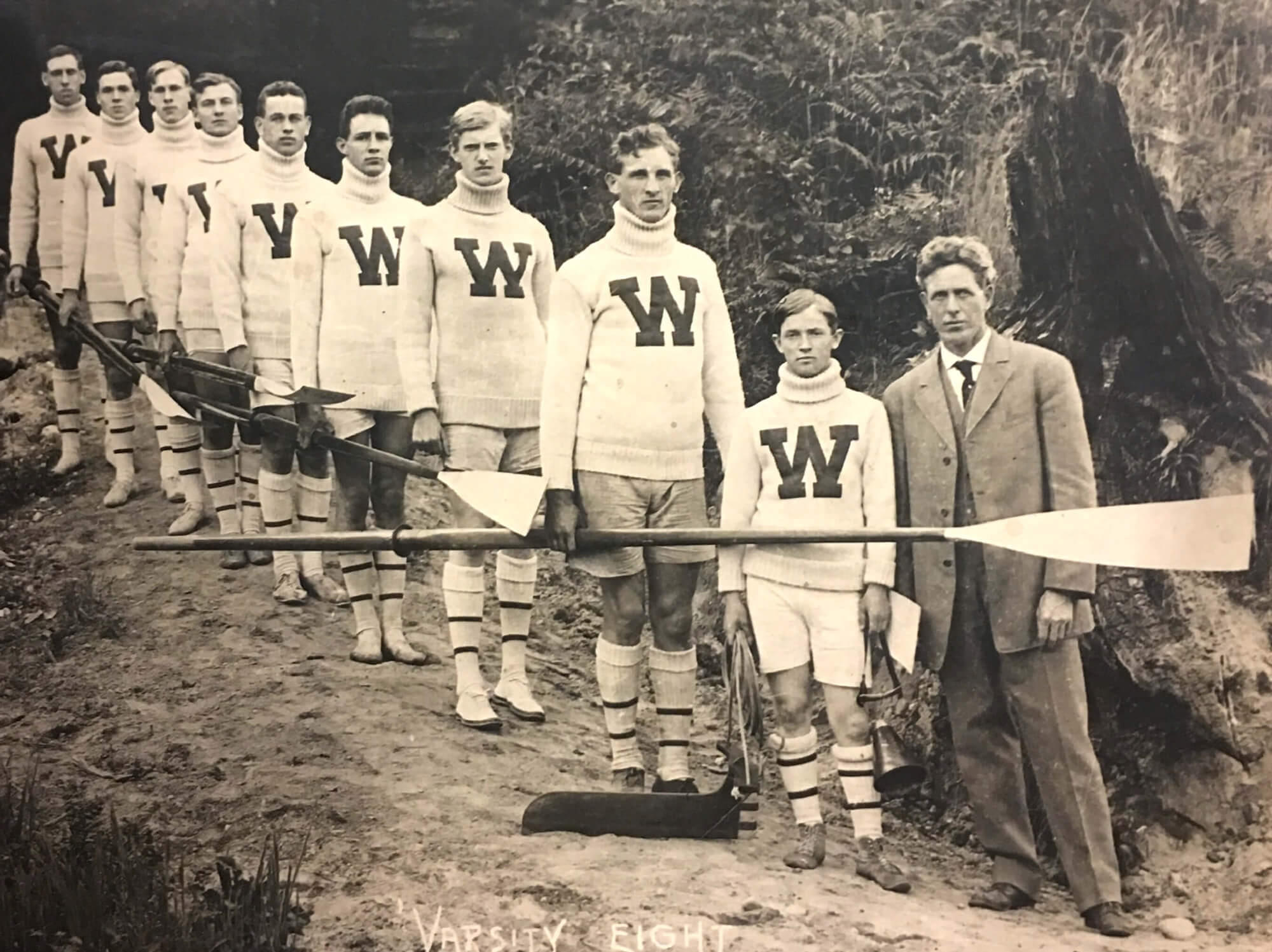
“The men won on their condition as much as anything else. Although not so large and strong as the Californians, they have the endurance…” said Conibear of his 1908 Varsity, in one of the first photos featuring Conibear’s white blades of Washington. “Honor is due to the second crew for their faithful turning out for months,” he continued, “even though they knew they did not have a chance of making the varsity [or having a chance to race] - thereby giving the first eight practice of that kind that makes a winning crew.”

Ed Leader

(1918-1922)

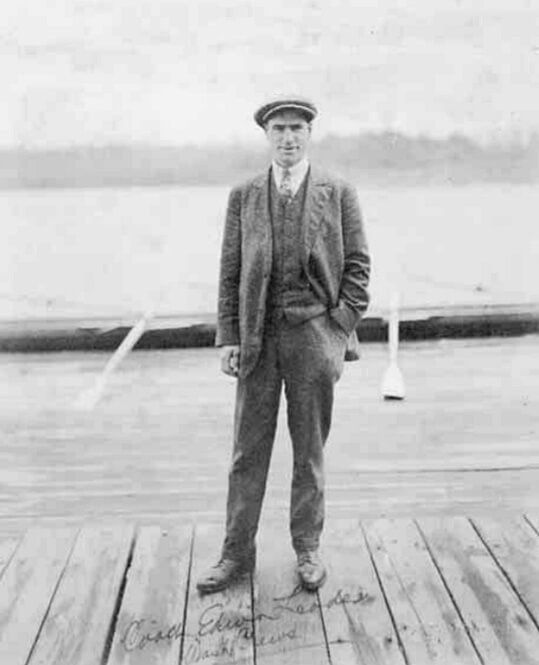
Ed Leader, a former oarsman under Hiram Conibear, took the helm of the program after Conibear’s shocking death in the fall of 1917. But with the outbreak of WWI, the campus was depleted of men, and the VBC shellhouse was quickly converted to a Naval training facility, with rowing suspended indefinitely.

By the Fall of 1918, with the war now over, men began to return to campus. But even so, Leader needed to quickly find a new home for his program. He serendipitously found that home on the northeast end of the recently completed Montlake Cut, a ready-built Navy Hangar that was offered back by the Navy to the University at the end of the war. Cold, dark, and built for airplanes, it was quickly (but practically) re-purposed by the ASUW as a shellhouse.

Leader would face a number of headwinds. Post-war America was different, and collegiate athletics were being deprioritized. Stanford – with a powerhouse rowing team at the time – cancelled their program (that would not return for three decades). Cal was looking for funding and a coach, and was on the edge of being cut. George and Dick Pocock had left for Boeing and were no longer building shells. At Washington, Leader was holding it together with the support of the Seattle community, the Rowing Stewards, and the ASUW, but his first two years were uncertain and lean. Still, throughout that time, he embraced the teachings of Conibear and inspired the men to perform on the water, finally getting back to the IRA in 1922 and stunning the national rowing community with a second-place finish, re-establishing the program as a contender.

That summer, Yale approached Leader with an offer to coach at the Ivy League school, and Leader agreed, convincing Dick Pocock to go with him to build shells in New Haven. By 1924, the two had quickly turned Yale into a powerhouse, winning the USA Trials and the 1924 Olympics in Paris. But he would leave the Washington program in solid standing and in good hands: Russell S. “Rusty” Callow, former ASUW President and another protégé of Conibear, was next up.

Ed Leader and the Washington Rowing Stewards never once gave up on the program and neither did Seattle, the city (with Leader’s tireless encouragement) raising $7,500 to send the team to the IRA in 1922 - and ultimately a stunning 2nd place finish. “Just wait until next year,” said an elated (and prescient) Brous Beck, Chairman of the Stewards.

Russell S. “Rusty”

Callow

(1922-1927)

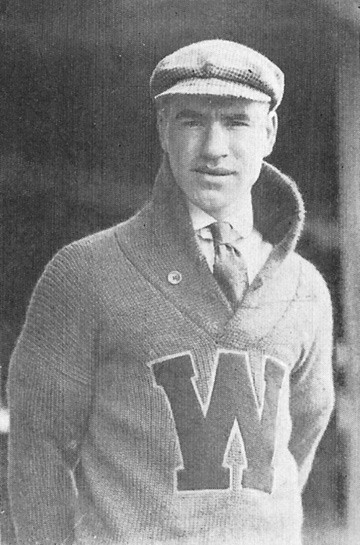
Rusty Callow – another oarsman trained under Conibear – took the reins in the Fall of 1922 and quickly set out to continue the momentum in the program.  In one of his first acts as head coach, he convinced George Pocock to leave Boeing and return to the University to build shells, offering to construct a second story shop for Pocock in the cavernous hangar turned shellhouse, which he completed in early 1923. Pocock then went to work on a new shell, delivered before the men left for the IRA’s and christened the Husky. Just weeks later at Poughkeepsie, Callow’s top crew would pull off a stunning upset in the marquee three-mile Varsity race, rowing the Husky to an open-water victory over the strong field, and the first National Championship for Washington in any sport.

Welcomed back to Seattle with a parade and a key to the city, Callow set out to rebuild his squad that Fall with an unknown sophomore stroke-oar named Alvin Ulbrickson. Ulbrickson was a natural, and by the spring Callow’s Varsity was swinging again; in an even more dominant performance at Poughkeepsie, the team won going away, a remarkable two-in-a- row for Callow, his JV’s finishing second.

The 1925 season played out similarly, this time the JV’s bringing home the win and the Varsity finishing second, but it was 1926 where Callow put it all together. With Ulbrickson back for his senior year and one of the best overall teams in the history of the program, Callow’s Varsity and JV would sweep the regatta.

The 1927 season would be the last for Callow at Washington, his Varsity finishing second and the JV’s winning again. But in just five seasons, Callow completely re-made Washington Rowing: bringing George Pocock back, capturing the essence of Conibear in his coaching style, and hiring Al Ulbrickson as his Frosh coach. “Rusty Callow had a rare ability to retain the respect of his crews and maintain the rigorous discipline needed for a successful team effort without killing their spirit,” said Pocock. “Rather, he raised it. I know it’s an overworked term, but Rusty Callow was in truth a real leader of men if ever there was one.”

Callow would leave to become head coach at Pennsylvania, receiving an offer from the Ivy League school that Washington could not match. He finished his career at Navy, coaching the famous Great Eight to Olympic Gold at the 1952 Olympics.

Following the IRA win in 1923, Rusty Callow was highly courted by east coast programs, particularly Harvard. But he had given his word he would stay for at least three years, saying, “Washington is my alma mater, isn’t she? I don’t say I will never coach in the east, but I do say there isn’t enough money in the mint to make me break my word to you.”

Alvin Ulbrickson

(1927-1959)

Alvin “Al” Ulbrickson became the youngest head coach at Washington in the Fall of 1927. The most successful stroke-oar in the history of the program to date, Ulbrickson had spent one year coaching the Frosh team under Rusty Callow before being elevated into the head coaching role at the age of twenty-four.

Ulbrickson grew up on Mercer Island, rowing roundtrip from home each day to attend Franklin High School in Seattle. Born to the water, Ulbrickson was as tough as he was smart, one of only a handful of athletes to earn Phi Beta Kappa honors at the UW School of Business. Nicknamed the “Dour Dane” by local sports columnists due to his often quiet and short responses to questions, in fact Ulbrickson was highly respected and liked by his athletes.

His early years at coaching were hit and miss, with only two years under his belt before the Great Depression slammed the brakes on athletics. Not only did enrollment decline at the UW, but those who were athletic enough to row often could not make ends meet in order to stay on the team. Even so, Ulbrickson was adamant about health and diet, and challenged his teams to daily competition and physical conditioning.

His first real success came in 1933, a year when the IRA’s were cancelled due to the Depression. A replacement, two-thousand-meter National Championship was offered in Long Beach, California, and Ulbrickson’s Varsity prevailed over Harvard, Yale, and Cornell, capping an undefeated season where they also defeated Cal at The Dual.

In addition, that fall, a group of freshmen turned out under frosh coach Tom Bolles (later Harvard’s head coach and Athletic Director) that would change the trajectory for Ulbrickson and Washington. A dominant class, the undefeated 1934 freshmen eight would coast to the National Championship at Poughkeepsie and would return, as one, to win the 1935 JV IRA as sophomores. But as has now become legend in both book and movie form, it was the ability of Ulbrickson to see beyond that potential, and put together one of the greatest line-ups in the history of the sport in 1936. Not only did his full team sweep the IRA in 1936 (the first team in history to do that), his ’36 Varsity 8 would go on to win the U.S. Trials, and ultimately Olympic Gold, in a surreal Olympic final in Berlin, Germany.

The 1937 squad would repeat the IRA sweep, with Ulbrickson now fully hitting his stride. His 1940 and 1941 Varsity eights were some of his best (both National Champions), only WWII cutting short the success, as Ulbrickson was named Washington Athletic Director during the war years. Immediately following the end of the war, Ulbrickson – along with a supportive Seattle community – played host to the nation for two blockbuster intercollegiate two-thousand-meter regattas in 1946 and 1947, with over 100,000 spectators lining Lake Washington in the spring of both years.

By 1948 the full team was back at the IRA, once again sweeping the regatta; they came close again in 1949, then came back in 1950 and swept it one more time. Four IRA sweeps in ten total IRA regattas (with no other coach or collegiate program coming close to that record until Michael Callahan), the ’48 season capped with another Olympic victory, this time in the coxed four in London. In 1952, Ulbrickson’s coxed four would also medal, this time with an Olympic bronze in Helsinki, his son Al Ulbrickson Jr. rowing in that boat.

The 1950 completion of the new Conibear Shellhouse on the east side of campus was a major milestone for Ulbrickson, finally moving out of the Navy hangar he called home for over twenty-five years and into a building specifically built for his team. Much in part due to the ’48 and ’36 Olympic victories (and the lobbying of the State Legislature by him and allies of the team), it was Ulbrickson that ultimately requested the building be named for Hiram Conibear.

Ulbrickson’s squad would ultimately top off his career with one of the greatest upset victories in the history of the sport. After being banned from the IRA in ’57 and ’58 due to a football team infraction, Ulbrickson took his team to Henley for the first time, only to come up short to the Soviet National Team in a semi-final. But behind the scenes, Ulbrickson (and the U.S. State Department) were quietly working on a re-match to take place in Moscow behind the Iron Curtain. That re-match was approved, and two weeks later Washington sat on the starting line in Moscow facing that same Soviet team. This time however Washington exploded off the starting line, slowly drawing away and winning by open water, a race covered internationally by live radio and stunning the sporting world.

Ulbrickson would return in the fall of 1958, but decided by New Year’s that after thirty years, it was time to retire. “With your uncompromising way of life as an example, your honest urging to ‘give the best that’s in us’ [and] stressing the need for teamwork…this lasts much longer and sinks much deeper into the lives of the men you have touched,” said one of his former athletes at his retirement. “Perhaps our practice of these values is the greatest tribute we can give.”

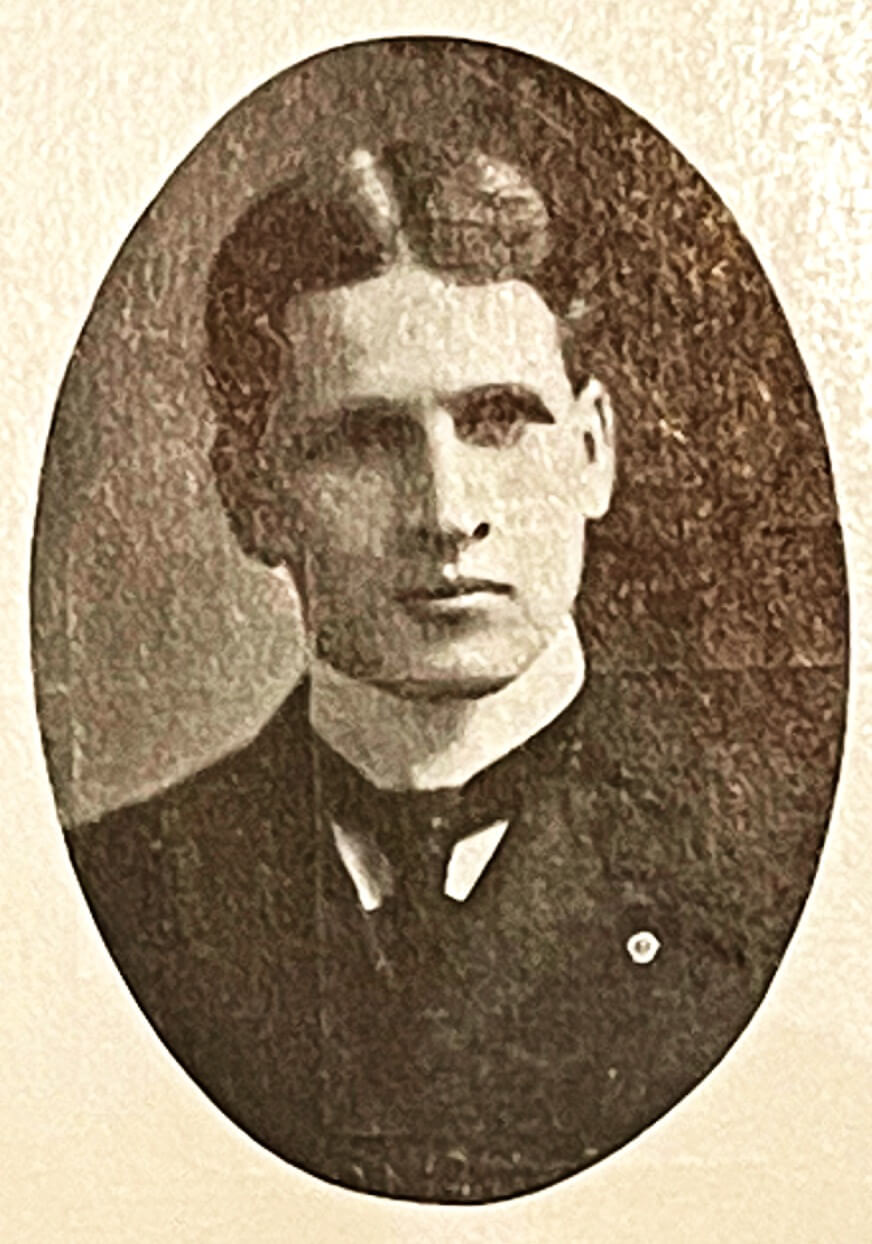
John Sayre, 1960 Olympic Gold Medalist and stroke of Ulbrickson’s final Varsity 8 that won in Moscow, said this about his coach: “They never quoted Al because usually what he said couldn’t be quoted. He would say ‘Sayre, you’re hunched over so far you look like a monkey peeing in a jar.’” But the encouragement was there too, Sayre recalling that at the end of his junior year, Ulbrickson approached him. “He said to me, ’You’re coming along fine, see you next year’… that inspired me so much I just floated out of there.”

John Sayre, 1960 Olympic Gold Medalist and stroke of Ulbrickson’s final Varsity 8 that won in Moscow, said this about his coach: “They never quoted Al because usually what he said couldn’t be quoted. He would say ‘Sayre, you’re hunched over so far you look like a monkey peeing in a jar.’” But the encouragement was there too, Sayre recalling that at the end of his junior year, Ulbrickson approached him. “He said to me, ’You’re coming along fine, see you next year’… that inspired me so much I just floated out of there.”

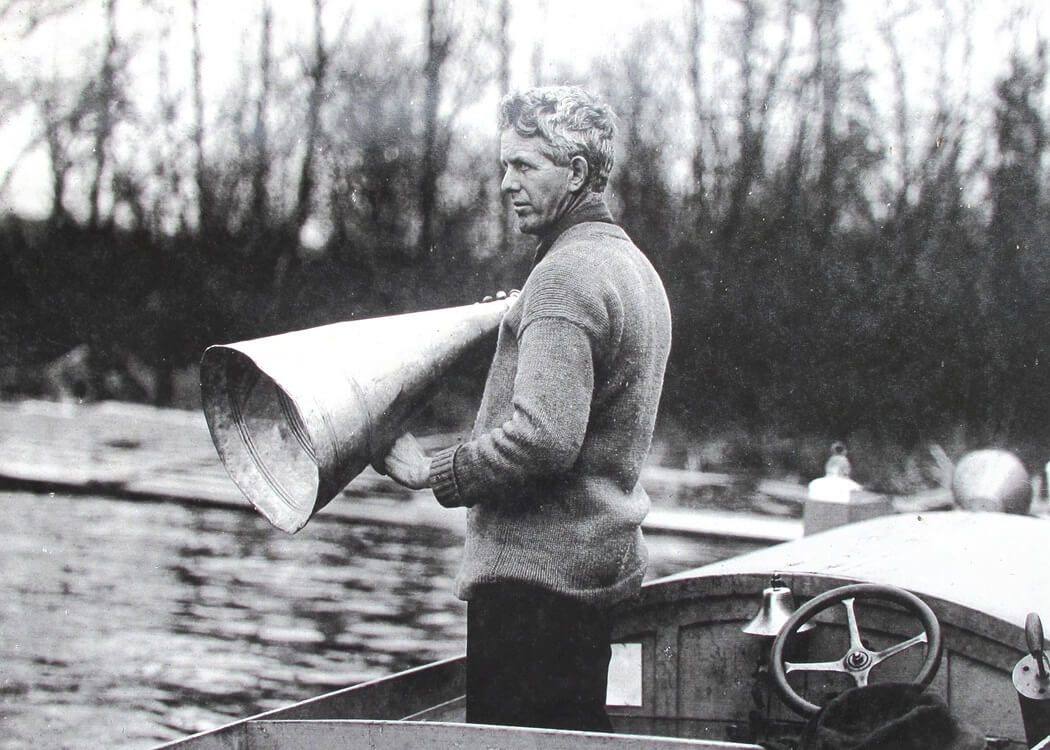
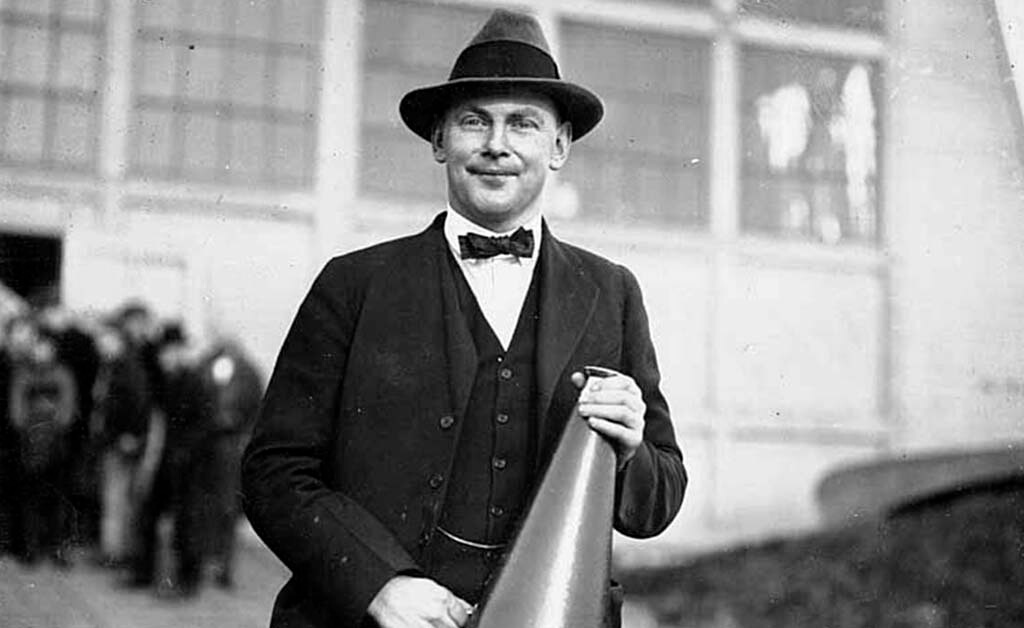
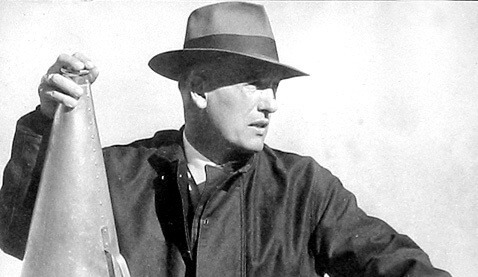
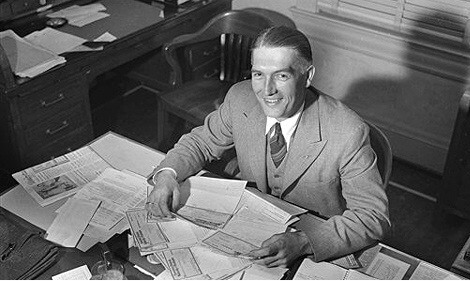
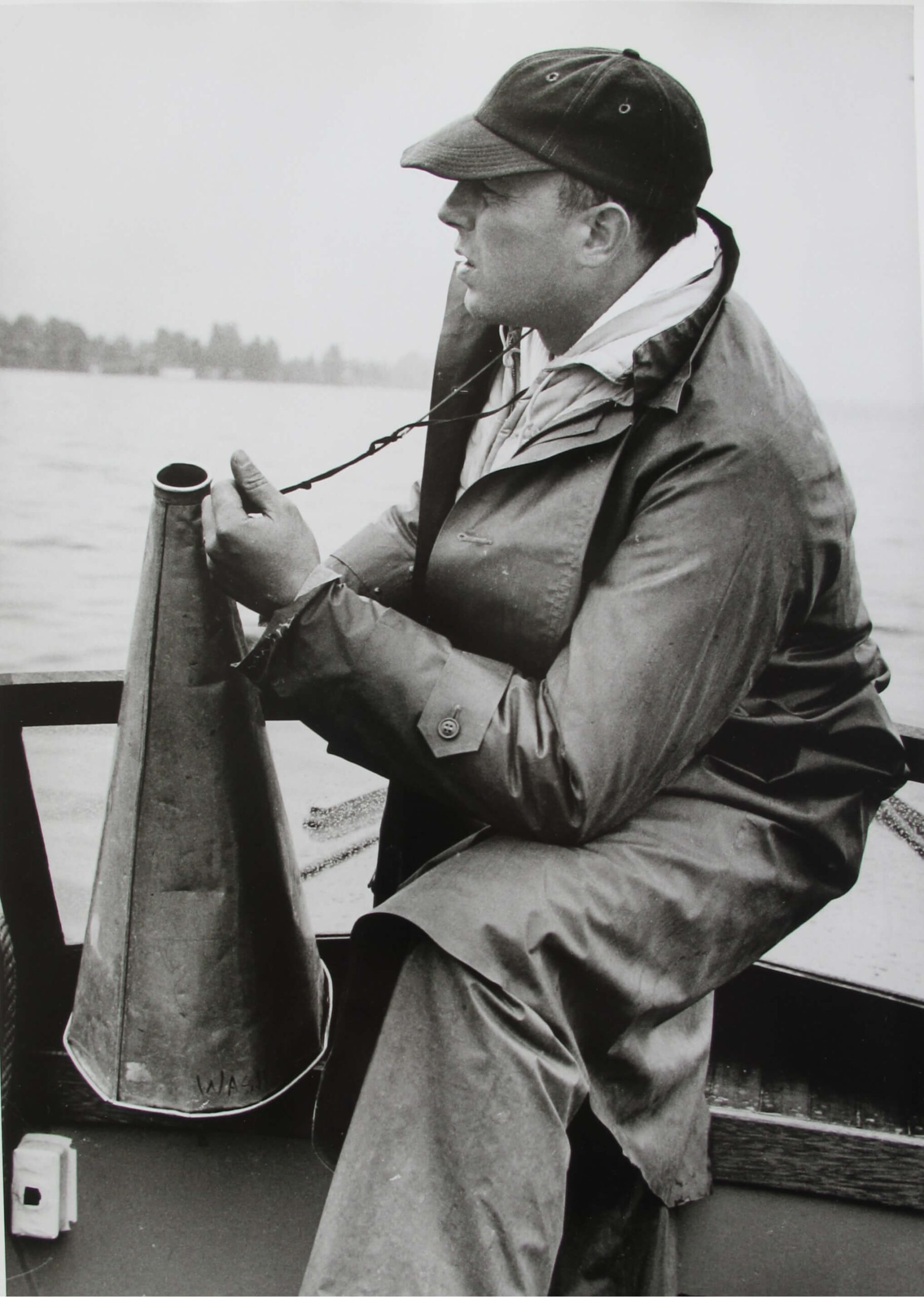
Al Ulbrickson at his Athletic Director’s desk during the war years. “For the past year, the silent, broad-shouldered coach has been filling in at Washington, a job he didn’t seek and for which he is not particularly fitted,” said Royal Brougham in a 1944 Seattle P-I column. “He’ll be happiest when he can again get out on the water in oilskins and a weather-beaten slouch hat, megaphone at his lips, teaching the smooth, powerful stroke first evolved by Hiram Conibear, which has caused the dilapidated shellhouse out on the canal to be recognized as the cradle of modern rowing.”

Matthew Fillip “Fil” Leanderson

(1959-1967)

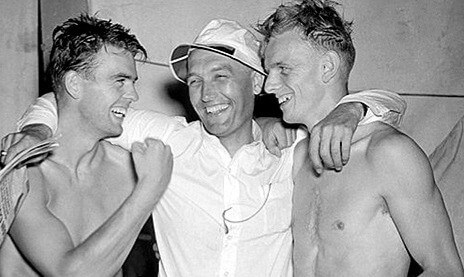
After three decades and some of the most legendary victories in the history of the sport, Al Ulbrickson would hand the reins to his freshmen coach, Fil Leanderson, to continue the tradition at Washington. Leanderson – an Olympic bronze medalist in the 1952 UW four with coxswain – had coached the freshmen for three years before assuming the head role.

With a priority on conditioning and a strong work ethic, Leanderson immediately went to work with his 1959 squad, and the team would not disappoint – winning the IRA “Ten Eyck” trophy for the highest overall team points. But maintaining the discipline and the focus in the early 60’s was not easy, with significant change taking place both on campus, and in the sport itself. And although his teams were consistently out-performing the competition on the west coast, the IRA’s were proving more difficult for a myriad of reasons.

The team would once again win the IRA Ten Eyck trophy as team National Champions in 1964, but rowing styles, strategies, and equipment were rapidly changing. Leanderson continued to motivate his squad however; both the 1965 and 1966 seasons featured deep and talented athletes, the ’65 team turning in one of the most remarkable turnarounds in the history of the program, sweeping the Western Sprints over some of the strongest competition to date.

Leanderson would step down after the 1967 season, ultimately coaching at Western Washington University for sixteen years, his teams winning multiple championships in a highly successful career.

Richard “Dick” Erickson

(1967-1987)

Dick Erickson took on the role of head coach in the fall of 1967, after coaching the Washington freshmen for four years under Fil Leanderson. Erickson – who rowed in the 2-seat of the 1958 Varsity that defeated the Soviet Union in Moscow – continued his graduate education at Harvard, and coached the MIT freshmen, prior to his return to Washington.

Highly energetic as a tireless innovator with a contagious personality, Erickson was very much cut from the same mold as Hiram Conibear. From the outset his teams performed: the 1968 Varsity finished second at the IRA (and qualified for the Olympic Trials); his ’69 team dominated the west coast; and by 1970 he had his first Varsity 8 IRA National Championship, with the team taking the Ten Eyck as well.

His 1971 Varsity was second at the IRA – but won the US Trials to represent the country at the Pan Am Games in Cali, Colombia, where they ultimately won the Pan Am silver medal. Erickson emphasized international competition from the beginning, finally ditching the IRA altogether (due to consistent conflicts with UW final exams, and the fact the best teams in the nation were no longer attending the regatta), opting instead to take his 1973 squad to Henley for the first time since he himself had rowed there as an athlete in 1958 under Al Ulbrickson.

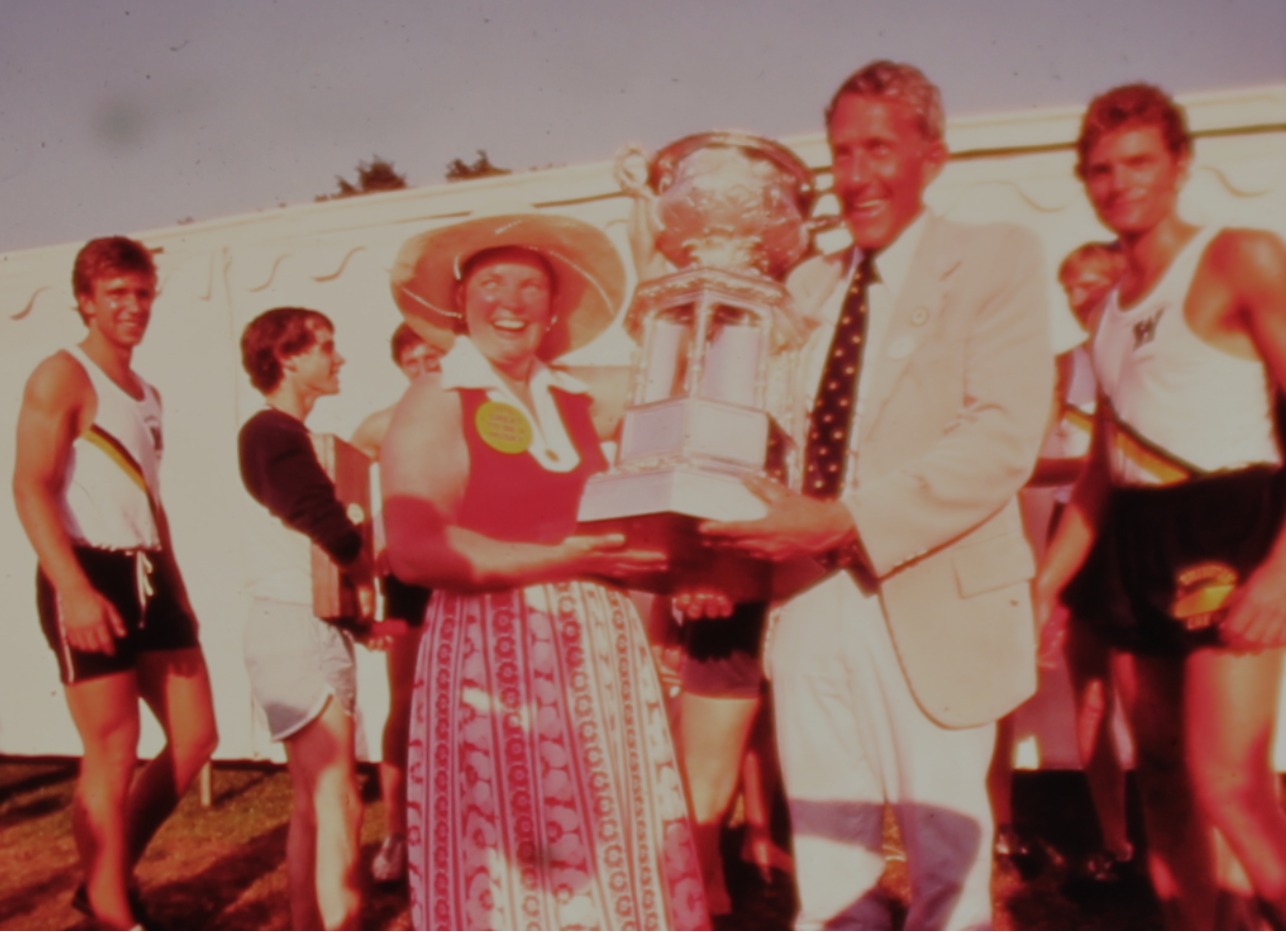
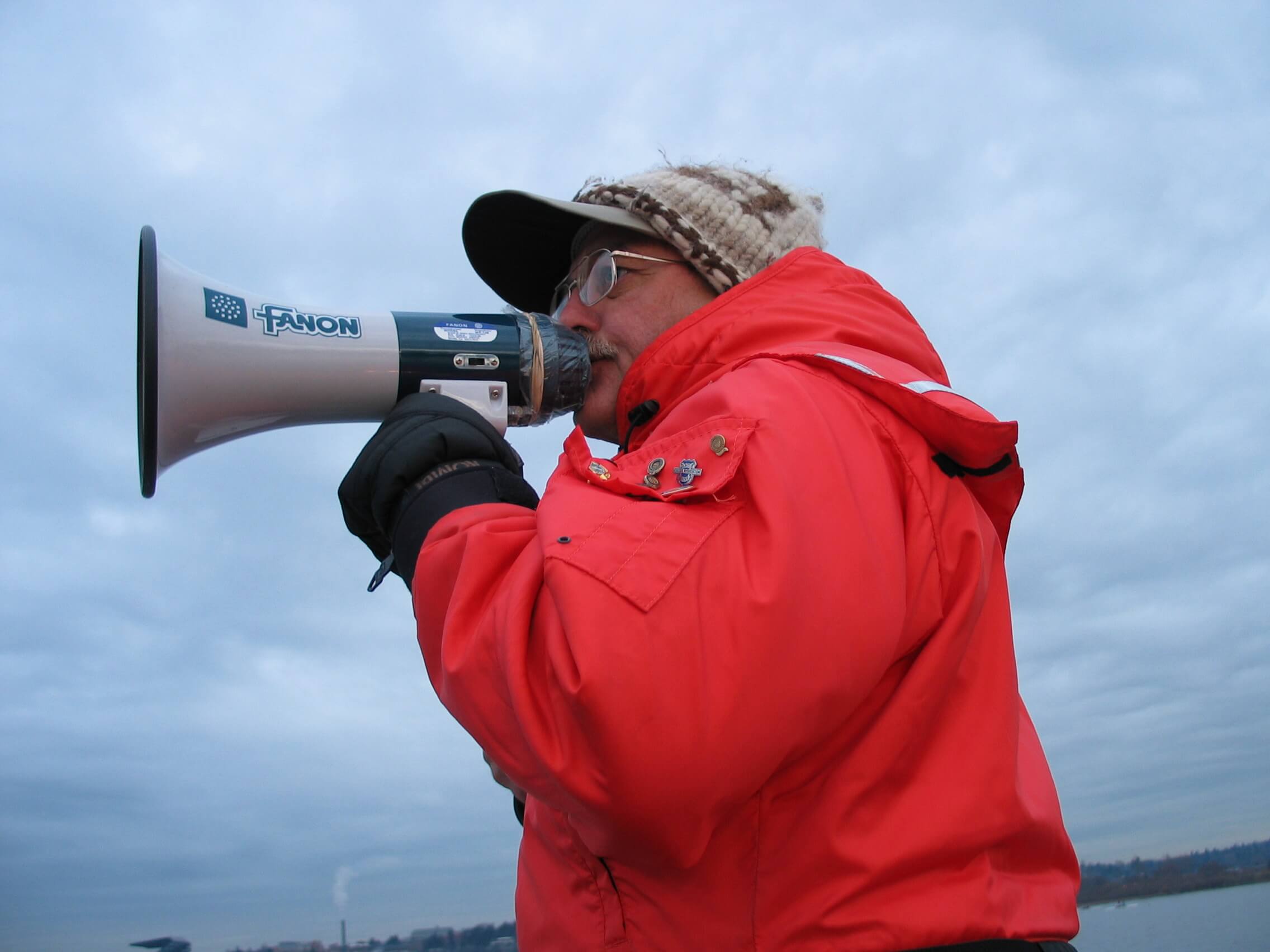
Throughout his tenure at Washington, Erickson was popular and well-known among the Seattle community. Joining with the Seattle Yacht Club in 1970, he introduced the first Opening Day races down the Montlake Cut, an event that was a major hit from the beginning; he then partnered with Windermere Real Estate to turn it into a global event in 1987. A tireless promoter of the sport, his featured speaking engagements were a way to raise money for the program and engage the businesses in the region; much like Conibear, he saw this as the life blood for the amateur sport he loved.

His 1977 team reached the pinnacle of the sport with victories in both the Visitors’ Cup, and the Grand Challenge Cup at the 1977 Henley Royal Regatta, with consensus National Championships in ’77, ’78, and ’81 (and a victory in the Ladies’ Challenge Plate at Henley by his ’81 2V crew). By 1978 he was taking his top crews to Egypt for an international race on the Nile (five years in a row), the news media characterizing his teams as “monster crews”, and Erickson becoming the talk of the town. Selected as the Seafair Parade Grand Marshall (the largest annual parade in Seattle), he was consistently found on local TV talk shows and newscasts at the peak of his career.

It was during Erickson’s tenure that Women’s Rowing grew from a club sport to a varsity sport at Washington in 1975, Erickson embracing the opportunity to expand the sport. “When women’s sports were coming around, he looked at all our resources and said to divide them equally among all the rowers,” said Jan Harville when asked about Erickson in 2001.”There were no differences between the men and women, that’s why we have been so successful.”

Even though the sport was rapidly changing in the 80’s (technology was significantly influencing coaching, boat-building, and training equipment), Erickson never hesitated to adapt. He was the first Washington coach to opt out of a Pocock cedar shell for his Varsity in favor of carbon fiber, a move that sent shockwaves through the rowing community. His 1983 team (second at the Cincinnati National Championship) and his 1984 team (National Champions at Cincinnati), were beneficiaries of his efforts at continued innovation and a constant reevaluation of the program.

Erickson stepped down following the 1987 season, but like Conibear his influence is still felt today. His redirection and emphasis on international competition, a strong commitment to Women’s Rowing, and the major impact he had on the Seattle rowing community – including northwest club, masters, and high school rowing (and the Windermere Cup Regatta) – solidifies Erickson as one of the most influential visionaries of the sport in Seattle and beyond. “I feel like I’m the luckiest guy in the world to have come here and worked with him,” said Bob Ernst in 2001. “Innovator and creator – those are the words that best describe him.”

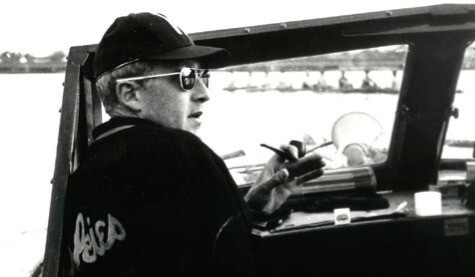
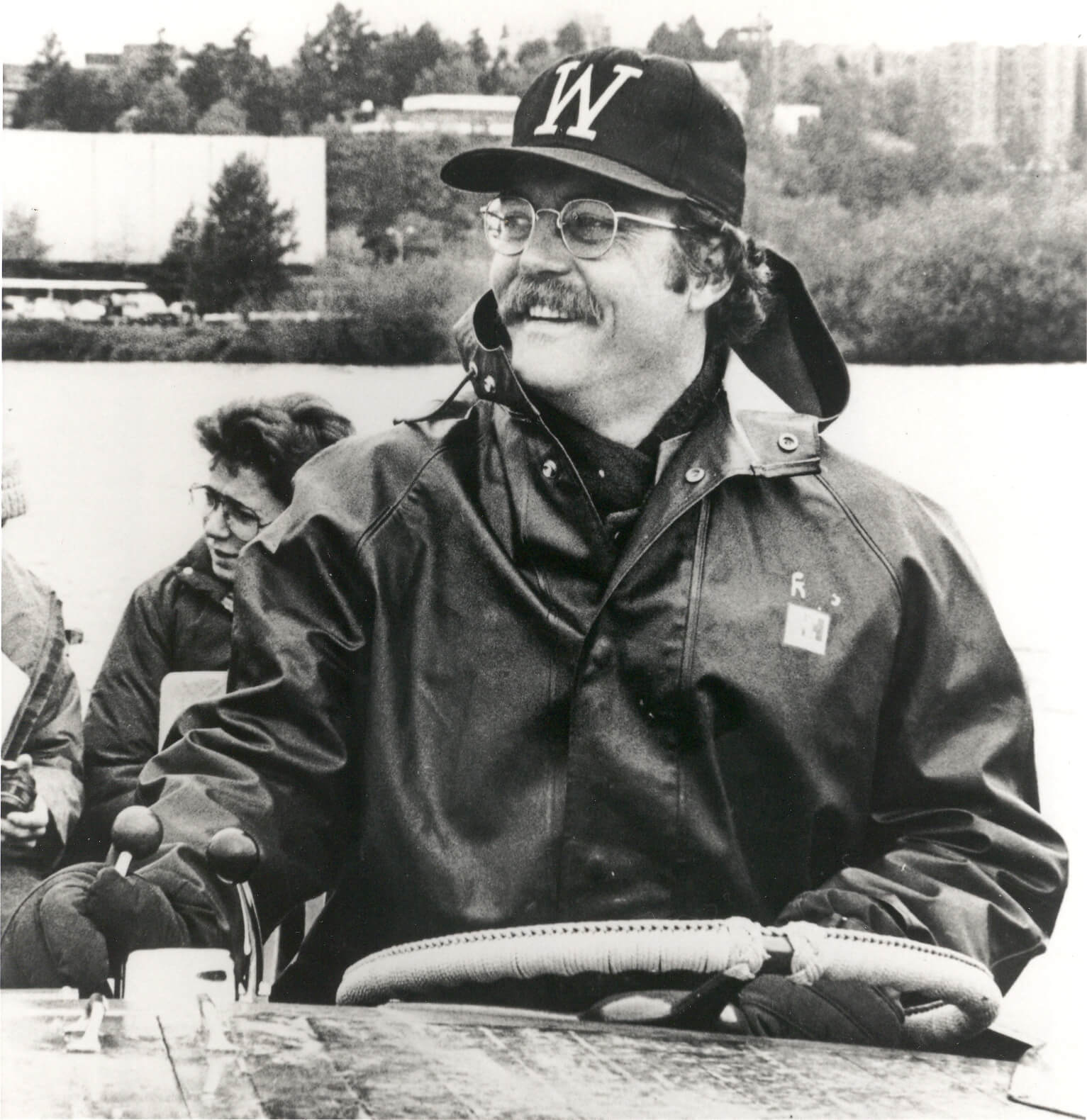
Erickson, pipe in hand in the “Hart” launch, somewhere on Lake Washington. After the Western Sprints victory in 1973 sealed his first team trip to Henley, Erickson said “It was a whitewash. It was the white blades of Washington all day – nothing but open water.”

Robert “Bob” Ernst

(1987-2007)

Bob Ernst took the reins from Dick Erickson in the fall of 1987 after finishing a seven-year stint as the head coach of the Washington Women from 1980–1987. In that short time, Ernst led his Washington Women’s teams to six National Championships, dominating the sport nationally – while internationally coaching the USA Women’s Eight to Gold at the 1984 Olympics. In his final season with the women, the team swept every event at the National Championships, his streak from ’81-’87 still unprecedented in the history of the women’s sport.

Ernst was first introduced to rowing while attending Cal-Irvine in the late 60’s, returning to coach the team in 1970. But it was his 1974 Cal-Irvine Varsity that caught the eye of Dick Erickson, pushing Washington’s top crew down the course to finish second at the Western Sprints. That summer Erickson would hire Ernst as the first Freshman Coach who had not rowed at Washington, but Ernst would not disappoint: of the six freshmen teams he would coach before moving to the women’s team in 1980, four of them would go undefeated, with all six freshmen teams winning the Conference Championship.

Ernst would coach the USA Women’s Team in four Olympics: 1976, 1980 (U.S. boycotted); 1984, and 1988. As the Washington head men’s coach, beginning with the 1988 season and into the early 90’s Ernst put an emphasis on technique and training, staying on the cutting edge of new technology, adding small boat training, winter camp, and expanding his team’s racing season and schedule, including a home/away dual with Wisconsin. It was ultimately Ernst in 1993 that sent his 2V8 back to the IRA for the first time since 1972, the crew winning the National Championship; by 1995 he was back to taking the full squad. In 1997 his team not only won the IRA Varsity Championship, but swept the regatta for the fifth time in Washington history.

The collegiate sport continued to evolve in the late 90’s, as top teams began to put an emphasis on foreign recruitment and scholarships. Like Conibear and Callow decades before, Ernst came to the Rowing Stewards in 2001 and presented the choice: compete or lower expectations. The Stewards did not hesitate: Ernst had his first scholarship athletes later that season.

The Centennial Celebration in 2003 brought all of the generations back together over the Opening Day weekend with a legendary banquet and celebration, Ernst playing a key role in re-inspiring the alumni base and raising the funds to modernize the shellhouse. By 2004 the university was breaking ground for construction, and in the spring of 2005 the doors opened to the new Conibear Shellhouse, a state-of-the-art rowing facility for both the men’s and women’s programs.

After winning another Varsity 8 and 2V8 IRA National Championship in 2007 – and taking home the Ten Eyck for the top team – Ernst would become the first men’s head coach in collegiate history to return to the women’s head coaching position, elevating his freshmen coach, Michael Callahan, into the role as men’s head coach. “I think the biggest story is really about Bob,” said Callahan in his first interview as head coach. “It says a lot about his character and it also says a lot about the University of Washington, how dedicated we are to having one equal team, equal and together. We find value in that, it’s a strong and clear value… and it says to young people out there who want to be leaders in the world – come to the University of Washington, and you’ll be among them.”

Michael Callahan

(2007 – Current)

No coach in the history of Washington Rowing has seen more success as a head coach than Michael Callahan. A tireless innovator and visionary in the sport of rowing, and a relentless adherent to the foundational values of Conibear and Pocock, Callahan’s influence on the totality of the program at Washington cannot be overstated.

A Class of ’96 Washington graduate (elected both Captain and VBC Commodore his senior year) Callahan rowed four years under Bob Ernst. He continued in the sport for multiple years on the US National Team, competing at three World Championships, the 1999 Pan Am Games, and finishing in Athens as the spare to the Olympic Champion US Olympic 8 in 2004.

In 2001, he began a coaching internship with Ernst, and following the Olympics, became Ernst’s freshman coach in 2004. His freshman team went undefeated in 2006, and following the 2007 season, Callahan was elevated to the head coaching role after Ernst returned to coach the Washington Women.

Callahan’s first season as head coach, in 2008, would begin one of the most dominant streaks in the history of collegiate rowing. Winning the IRA Ten Eyck Team Championship in 2008, his 2009 Varsity 8 would win his first National Championship in one of the greatest comebacks in regatta history, sealing the eights sweep (V8, 2V8, F8 all gold) for the sixth time in UW history.

Following another Ten Eyck Trophy performance by the team in 2010, Callahan’s Varsity 8 would then begin a streak of five straight National Championships from 2011-2015 – the longest in Washington (and collegiate rowing) history – adding three more eights sweeps in 2012, 2013, and 2015. With additional team Ten Eyck Trophies in 2017, 2018, and 2019 (prior to the Covid season cancellation in 2020), the team came back with another Varsity 8 National Championship at the 2021 IRAs (swept); then again in 2024 (swept), and added another Varsity 8 NC in 2025. In total, Callahan’s teams, in his eighteen years as head coach, have won nine Varsity 8 IRA National Championships; fourteen IRA Ten Eyck Team Championships; and have swept the 8’s events at the National Championships six times (no coach is close to that in collegiate rowing history), all unprecedented in the history of Washington Rowing.

On the international stage, Callahan has coached his Washington teams to Henley (England) Championships five times. As a USA National Team coach, he led the USA U-23 team (under 23 years old) to World Championships in the Men’s Eight twice, in 2008 and in 2018, and in 2024, he coached the USA Men’s Eight to an Olympic bronze medal at the 2024 Paris Olympics. Eighteen years into his career and it would take pages to list all of the team and individual awards Michael Callahan has received: Twelve Pac-12 Coach of the Year awards; US Rowing Man of the Year; Order of Iikos (2024 USA Olympic Team), to name a few.

All of that, and it is unlikely Michael Callahan would measure his success in any of these terms. Early on in his career he began the “Beyond the Boat” program to expand the core team values for his athletes’ life outside of rowing. His prioritization of personal character and individual growth, within the framework of the Conibear and VBC values, has been a key part of his success. In addition, he has proven to be highly effective at hiring high-level assistant coaches, continuing a tradition at Washington of mentoring future coaches into collegiate programs and US National Team positions.

Much like his predecessors, Callahan has worked tirelessly with the Seattle community and with his strong alumni support groups to maintain the competitiveness of the Washington program. This has been particularly challenging as collegiate sports have significantly evolved in the last decade, but it has not swayed his vision or his commitment to his teams, or the traditions at Washington. “Trust, teamwork and perseverance — Ulbrickson, Bolles and Pocock taught those values then, and we teach them today,” said Callahan reflecting on the history at Washington. “In rowing, the correlation between hard work and success is almost a straight line. The harder we work, the better we develop these guys, and the better they get.”

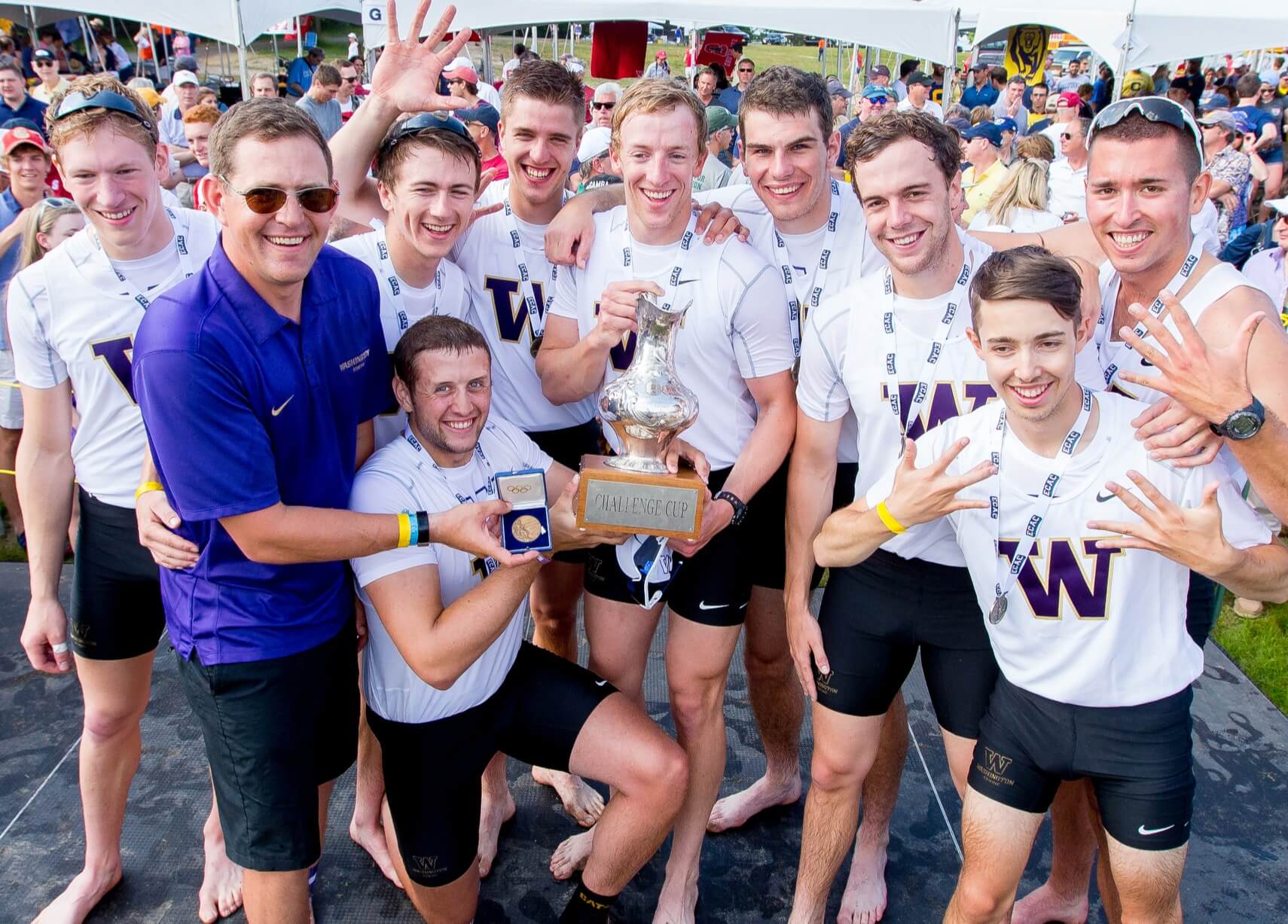
Callahan with his 2015 Varsity 8 on the IRA podium after a record breaking fifth National Championship in a row, holding Carl Lovsted’s bronze medal from the 1952 Olympics, the namesake of the new varsity shell in 2015. "There's greats before us and they set the standard, and now it's our job to reach that standard or to exceed it," he said.

Callahan with his 2015 Varsity 8 on the IRA podium after a record breaking fifth National Championship in a row, holding Carl Lovsted’s bronze medal from the 1952 Olympics, the namesake of the new varsity shell in 2015. "There's greats before us and they set the standard, and now it's our job to reach that standard or to exceed it," he said.

“It's very important to the University of Washington to have a deep team and not just emphasize one eight," said Michael Callahan at the IRAs. "We emphasize the whole team, from the guys in the last boat to the guys in the first boat. It's kind of our philosophy that the guy in the 3V is pushing the guy in the 1V. It's a tribute to everyone back at the boathouse who didn't make this trip, everyone who was here, the alumni. Everyone identifies with that in our culture at Washington.”

“I have often wished that Connie’s hecklers could have witnessed the finish of that race – could have watched the Stars and Stripes raised in triumph over the world. If they had, they most assuredly would have known what Connie meant when, with tears coursing down his cheeks, he implored: ‘Stick by me, because we are on the road to something really worthwhile.’”
Al Ulbrickson,
in the June 19, 1937 Saturday Evening Post, reflecting on the 1936 Olympic victory and the influence of Hiram Conibear (“Connie”) on Washington Rowing