
The Dual: UW vs CAL

The Dual: UW vs CAL

Tradition

There are not many traditions in the collegiate rowing community that match the color, consistency or intensity of the Washington/California rivalry.

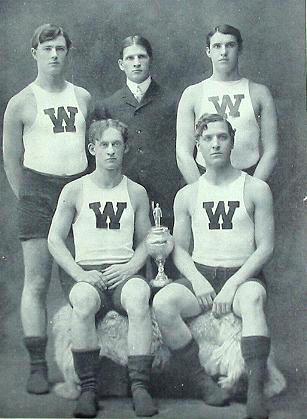
Since the first 1.5 mile race in fours on Lake Washington on June 3, 1903, these programs have set aside a weekend each year to race, even if it meant for the first 60 years loading shells onto steamships or railcars to make the 800-mile trip.

Add to that the fact that these two teams – both men and women – have consistently been two of the strongest rowing programs in the nation, and you get an annual event that is as good as it gets to anyone who follows collegiate rowing in our country.

The Washington-California men’s varsity eight dual series dates back to 1903, with 107 meetings between the two schools. UW currently leads the varsity series 78-34-1. At stake is the Schoch Cup, named after Delos “Dutch” Schoch of Washington’s class of 1936. Schoch lettered three years (1934-36) as a Husky oarsman and was the spare to the 1936 Olympic team.

On the women’s side, the Washington-California women’s varsity eight rivalry dates back to 1977. The Huskies lead the series 27-21, and at one point won 22 of 23 races between 1981 and 2003.The women compete for the Simpson trophy, which was donated in 2003 by longtime Washington supporters Hunter and Dottie Simpson, whose daughter Anne rowed at Cal. Members of the Simpson family are traditionally there at the race to award this special trophy to the winner of the women’s varsity eight race.
The Dual UW vs Cal

Milestones

If it can happen, it probably has happened in this race. Boats have sunk. Boats have collided. There is the infamous race in Seattle in 1914 where races were started at both ends of the three-mile course and the crews barreled through each other midway. Steering has been lost, launches with coaches have collided and sunk midrace, rowers have been ejected, athletes have collapsed, and logs, buoys, and bridge abutments have been struck. And the racing… races have come down to the wire so many times it would be difficult to recount them all.

Intertwined in this tradition are the legendary coaches. Ky Ebright was a coxswain at Washington under Hiram Conibear in 1916, then coached at Washington under Ed Leader, but left for Cal to keep that program alive after the WWI post-war culture cast a pall on intercollegiate sports in the early 20’s (Stanford’s highly successful rowing program was cancelled then and would not resurface for close to 30 years). His success at Cal (including Olympic gold in 1928, 1932 and 1948) established their program as the powerhouse they remain today.

For decades it was Ebright vs. Ulbrickson, two heavyweights battling it out on the national stage (and sometimes with global implications). Then came the Erickson and Gladstone years, two visionary coaches, both with a passion for international competition; then on to Bob Ernst… and Gladstone back at Cal for round two. For much of the latest century it was Michael Callahan and Mike Teti – two of the sport’s coaching titans – battling it out, with Scott Frandsen now at Cal producing some of the finest teams in their history. On the women’s side, it was Ernst who brought the first women’s V8 win to Washington in the Dual in 1981, then Jan Harville producing championship crews in the 90’s and into the new millennium at Washington, while Dave O’Neill re-built the women’s team at Cal into a premier program. Most recently it has been Yaz Farooq at Washington (NCAA titles at UW 2017, 2019) and Al Acosta (NCAA titles 2016, 2018) at Cal, two of the very best women’s rowing coaches in the world.

With the Pac-12 dissolving in 2024, Cal and Washington went separate ways, Cal to the ACC, and Washington into the Big 10. But even so, do not expect this rivalry to wane; the connection between these two programs runs too deep, the history and tradition too strong. “The Dual really stands alone. You can’t go in it into it with any expectations because you know that both teams are going to bring their very best,” said UW women’s head coach Yaz Farooq. “This is the race of the year,” UW men’s rowing head coach Michael Callahan has said. “Everyone understands rivalries. This is a high-pressure situation and these races tend to go the distance. We like that challenge.”

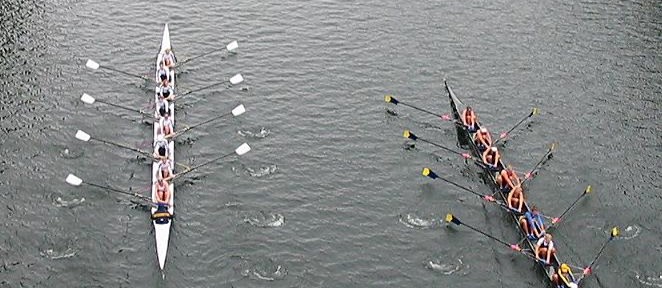
The Dual on the Montlake Cut, April 2025

The Boys

In the Boat

The recent success of the book The Boys in the Boat has cast a spotlight on the 1936 Washington team, and recounts vividly the journey of one crew from formation to victory. But this team is not alone in this legacy; many of the men and women that row for Washington and California lead similar journeys each year. Some go on to championship victories or national teams. California won gold at the 1928, 1932 and 1948 Olympics.  Even so, some of the most memorable wins for anyone who has rowed for either of these schools comes at the Dual. Blame it on tradition.

Meaning of

Dual

The term “Dual” comes from the shortening of the phrase “Dual Meet,” meaning a competition between only two teams. The phrase is still used, particularly in track and field (“dual meet”), but for rowing the “Dual Regatta” would be an unlikely description today (although 1940 was a different story!).  Still, the term “Dual”, used for decades to describe the Cal/Washington race, has stuck, as it does carry with it a sense of tradition and is now synonymous, at both boathouses, with this race. Ask anyone at Conibear Shellhouse or Ky Ebright Boathouse what “The Dual” is, and you will likely get a short, very precise answer. UW versus Cal.

The history content on this website is copyrighted © 2001 – 2026 by Eric Cohen, ’82, Team Historian.